A large number of people who lose a big chunk of weight will unfortunately gain it all back (and sometimes more).
When talking to our clients, prior to joining the team, many struggled with constantly being stuck in a cycle of losing and regaining weight.
The problem?
Our environment isn’t set up for us to stay lean.
→ There is fast food everywhere
→ Delivery is incredibly easy
→ You can outsource things like cleaning to robot vacuums, mops, and other machines
→ You can drive anywhere you need to go and more people are working from home than ever
It’s so easy to move and eat more.
So it’s no wonder that you can get through a few months of dieting and lose the weight.. but when you finally let loose post-diet, you up regaining the weight, due to your current environment.
Today's blog teaches you the 5 keys we teach our clients to ensure you're able to keep the weight off long-term, and turn having the physique you want into a sustainable lifestyle.
1. REVERSE DIET PROPERLY
The first thing to do post-diet to make sure you maintain your results is to exit the diet with a reverse diet plan.
Reverse dieting is a way of bringing your food up in a systematic way so that you aren’t outpacing your metabolism.
When you diet your metabolic rate slows down. There are a few mechanisms for this slowdown.
The components of your metabolism are:
→ Basal metabolic rate (BMR) - this is the calories your body burns at rest just to keep you alive. This is to fuel processes like keeping your organs functioning–heart beating, lungs breathing, etc. while you rest.
→ Non-exercise thermogenesis (NEAT) - These are the calories you burn by not exercising. These are all the little movements you do throughout the day that aren’t structured. Think things like pacing around, blinking, fidgeting, typing on the computer, tapping your foot, etc.
→ Thermic effect of food (TEF) - These are calories burned through the digestion of food.
→ Exercise activity thermogenesis (EAT) - These are calories burned during structured exercise–your training and/or cardio.
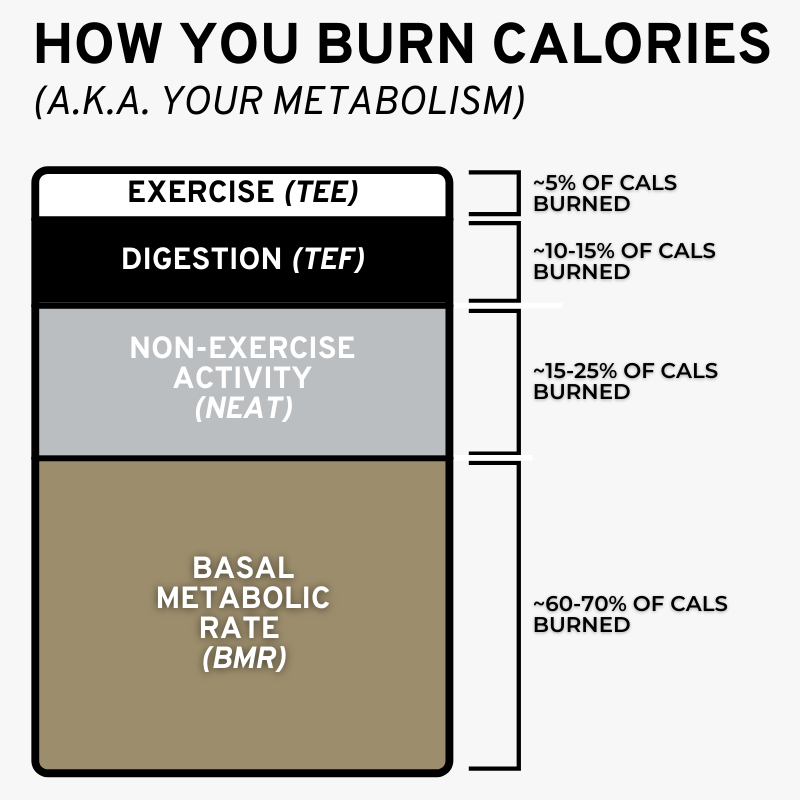
When you diet all 4 of these components are gradually slowed.
Your basal metabolic rate can slow because you’re smaller and hormones like thyroid hormone output can be altered by your body in an attempt to conserve energy.
Your NEAT will naturally decline because you’re in a calorie deficit and your body wants to conserve that energy expended through spontaneous movement.
You’ll also burn less calories through NEAT because it takes less calories to move around a lighter body.
TEF lowers because you aren’t eating as many calories.
EAT lowers because you will burn less calories doing the same activity with a lower body weight.
If you end your diet and go immediately up to what “should” be a maintenance intake, you’ll outpace the reverse of these adaptations and gain weight.
If you spent a really long time dieting and/or were in a very aggressive deficit the adaptations will be more extreme and your reverse diet may need to be more gradual.
If you dieting for a shorter amount of time or were in a much smaller deficit you won’t have to take it quite as slowly.
Another factor in how quickly you can reverse diet is how lean you got in your diet.
If you are a lifestyle dieter who just needed to lose some fat to get into a healthier range, you can likely reverse a bit slower because you won’t be experiencing any negative health effects from the level of leanness you achieved.
If you are someone who is either a competitor or a photoshoot prep client you will probably need to jump up to closer to an estimated maintenance range and accept a little bit of fat gain in the beginning of a reverse (because in this case your main goal is to get out of the deficit and add a little bit of bodyfat for health.)
On the slower end of reverse dieting you can add in small increments every 1-4 weeks.
The macros you add will depend on what your macros ended up at, but typically you will begin by getting fat to a healthy minimum (0.3-0.4g/lb of bodyweight) and then focus on just adding carbs from there.
On the quicker end of a reverse diet you’d want to begin by jumping calories up to about 90% of an estimated maintenance calorie intake.
From there, you can finish the reverse by using the slower approach discussed above.
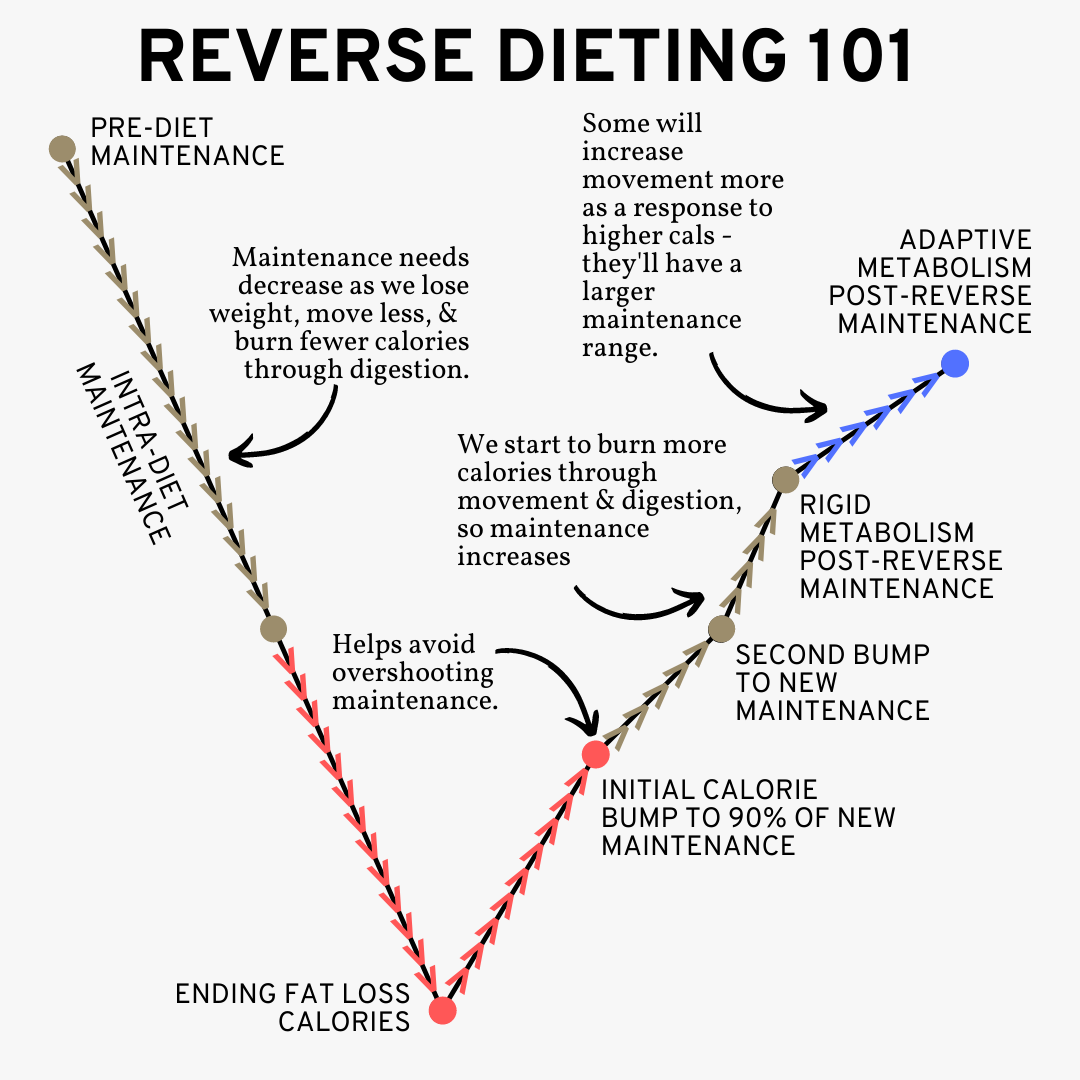
You know when to end a reverse diet by watching the scale, pictures, and biofeedback.
In the first weeks of a reverse diet you will gain weight. This does not mean you are necessarily gaining bodyfat (although there might be a little bodyfat necessary if you got extremely lean.)
What you will gain is water. When you eat carbohydrates they are stored in the muscles as glycogen. Each gram you store of glycogen brings along 3g of water with it.
You’re also going to gain water from any extra sodium in or on your food.
Another thing that will cause scale weight to go up is having more food in your digestive tract.
You’re eating more food, so when you step on the scale that food is in your gut and will be reflected in your scale weight.
All of these are really good things and don’t mean you’re doing anything wrong in your reverse diet. (We have a full blog on reverse dieting HERE if you want to go in depth on this subject!)
2. EAT MOSTLY WHOLE FOODS
Anyone who keeps weight off long-term is going to be eating mostly whole foods.
Whole, unprocessed foods are more filling calorie-for-calorie than any processed foods, and they’ve also been found to have a higher thermic effect than processed foods.
Making the switch from processed to unprocessed foods is a simple way to reduce the total calories you’re eating without feeling hungry all the time.
This doesn’t mean you can never have anything processed, but if you’re filling your entire day with packaged food it’s really easy to go beyond maintenance calories without feeling like you’re eating much.
When you think of processed foods you’re probably thinking of things like pizza and donuts.
Those foods have a mix of fats, sugar, and salt that makes it extremely hard to stop eating when you’re full.
You get a dopamine release from those types of foods that you won’t get with something like chicken breast, broccoli, and rice.
A lot of processed snack foods also have people employed by the company to get all the flavors and textures just right to make it very hard to stop eating them. (Side note: if you’re interested in this kind of thing, The Hungry Brain by Stephan Guyenet is an excellent book that dives into all of this in detail.)
You can also think of processing in the terms of how a food is actually prepared.
Think of an apple vs. apple sauce vs. apple juice.
You could drink a glass of apple juice and get 60g of carbohydrate in that glass without making a dent in your hunger.
In order to get that from apples you’d need to eat 2.5 apples, which would also give you about 12g of fiber and you’d probably feel pretty full.
Staying close to the form your food was grown in will make it literally hard to overeat, making your weight loss and weight maintenance much easier.
3. EAT A PROTEIN-CENTRIC DIET
Protein is a great weight management tool and has a ton of effects that make it a powerful tool for maintaining lost weight or making fat loss easier:
First of all, protein has the highest thermic effect of food of all the macronutrients.
Protein digestion will burn about 25% of its calories, while carbs will burn about 10-15%, and fats about 0-5%. That’s a fairly small thing when you’re looking at numbers, but combined with it’s other benefits it’s meaningful.

Protein is very satiating. If you’re filling up on protein first, it’s going to be a lot harder to over consume calories afterward.
Protein-rich foods tend to be relatively low calorie.
This isn’t in comparison to something like spinach…but if you’re looking at something like a chicken breast compared to a dish that’s not protein rich like pasta, sandwiches, casserole, etc. a protein centered meal tends to be lower calorie overall.
Protein helps you build and maintain muscle.
The more muscle mass you have, the higher your metabolic rate will be. You’ll burn more calories at rest, during movement, and have a larger storage capacity for carbohydrates.
Protein is very unlikely to be stored as bodyfat. Even when consuming more than maintenance calories from protein, studies have found that participants not only didn’t gain as much body fat as participants who overate the same amount via carbs and fats, but they actually gained muscle mass (meaning they ended up leaner than when they started.)
→ In a study by Jose Antonio one group overate by 800 of carbs and fats and one group overate by 800 calories from protein. These were people who were resistance training. From the article:
“It is notable that the high-protein group increased FFM (+1.9 vs. 1.3 kg) and reduced FM (−0.2 vs. +0.3 kg) compared to the control group despite eating an additional 800 kcal/d."
→ In a follow-up investigation, Antonio et al. randomized 48 healthy, resistance-trained men and women to consume a minimum of 3 g/kg of protein daily or to maintain current dietary habits for eight weeks while undergoing a standardized resistance training program designed to increase lean body mass.
(4) Compared to the control group, the high-protein group consumed significantly more calories (+ 490 kcal) and protein (3.4 vs. 2.3 g/kg) from primarily whey protein shakes, leading to a diet that was 39% protein, 27% fat, and 34% carbohydrate.
Both groups significantly increased FFM and significantly reduced FM compared to baseline, but the reduction in FM was significantly greater in the high-protein group compared to the control group (−1.6 vs. −0.3 kg). Accordingly, body weight gain was also significantly less in the high-protein group compared to the control group.”
Translation: Even in a calorie surplus, overeating protein while resistance training leads to more muscle mass and less body fat.
We recommend to our clients around 0.8-1.2g/lb of body weight in protein per day, but these studies suggest that if you digest it ok and you have high hunger that makes it hard to stick to your target calories, it’s ok to go above that number.
When you’re looking for good protein sources in your diet, you want to look for foods that are predominantly protein.
Meaning, while things like beans and peanut butter are healthy foods, they’re not protein sources as they contain more carbohydrates and fats, respectively, than they do protein.
Things like lean meat, eggs and egg whites, high quality protein powder, low-fat dairy, and fish are all great sources of protein to build a meal around.
4. TRAIN CONSISTENTLY
Training consistently helps you maintain weight through several different mechanisms, and it’s not just that training burns calories…in fact that’s probably the least significant reason it helps you maintain fat loss.
Resistance training builds muscle. The process of building muscle is a calorie-expensive process.
You have to burn calories to train. This sends a muscle building signal that builds the tissue, which allows you to then burn more calories, both at rest and during activity (because you’re more dense and sometimes more heavy as you build more muscle.)
Muscle also acts as a storage container for carbohydrates. The larger the muscle, the more glycogen it can hold.
If the carbohydrates you’re eating are being stored as glycogen in the muscle they’re not using as much insulin, not floating around as blood glucose, and not being stored as fat.
All of this means that to an extent, the more muscle mass you have the healthier you’ll be.
Training also helps regulate appetite.
A study of Bengali millworkers found that the more sedentary workers actually had a more dysregulated appetite that led them to overconsume calories, whereas the workers that were more active had appetites that matched their energy output.
The lightly active workers had blunted hunger, and the more highly active workers had a higher hunger that matched their calorie expenditure.
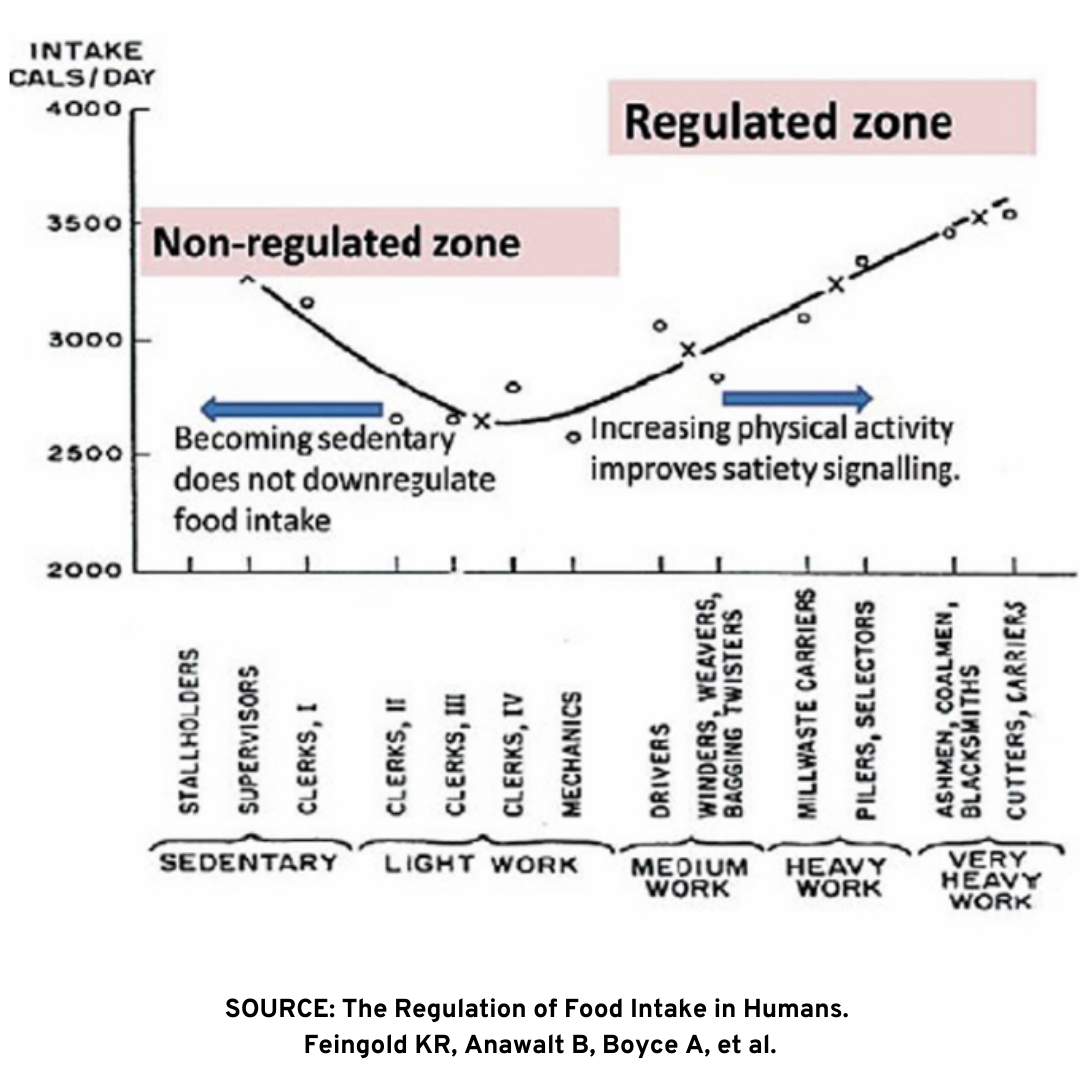
Appetite response to activity is pretty individual; some people are ravenous after doing a hard workout and some people feel like they can’t eat anything because their appetite is completely gone for a while after training.
Either way, staying active can help you regulate your intake over time.
On a more practical level, working hard in the gym seems to have a psychological effect in regards to diet. If you’re working hard in the gym it’s easier to stay on track with your diet because you’re more in a mode of doing things that are good for your body, and the opposite seems to be true, too.
5: DESIGN YOUR ENVIRONMENT FOR SUCCESS
People without weight struggles tend to keep their environment set up for success in that area.
If you are working or living in a space that’s full of your favorite junk food you’re much more likely to have more of it just because it’s there.
With so many people working from home this is now more evident than ever. You’re either out of the office that was full of tempting junk food OR now you’re right there a few steps away from your pantry full of tempting junk food.
Believe it or not, this has been studied.
Office workers set a dish of chocolate candies either on their desk, in a drawer, or across the room in a cabinet. The workers who had them on their desk ate an average of 9 candies, the ones with the candy in the drawer had 6, and the ones with the candy in the cabinet had 3.
When it’s something that doesn’t support your goals, out of sight and out of mind is best.
To take this principle into real life, if you are a parent with kids you are likely to have tempting snacks in the house. This is a challenging scenario. When it’s just your own snacks, it’s easy to simply tell yourself to not buy the food. When it is for the kids it’s a different story.
The first thing to try (if you truly don’t think this is a healthy food for you or your kids to have), is to not purchase the food and keep it in the house and instead go out for it on a special occasion.
This might be hard (at first), but in the long run everyone will be healthier and happier with making it a special treat.
If it is a healthy food for them and just doesn’t fit your calorie targets on a consistent basis, you can use some environment design tactics to help.
→ Put things in an opaque container and on a high or low shelf, out of the line of sight. If you don’t see it constantly, you’re much less likely to be tempted.
→ Put things into pre-portioned baggies. Eating things out of the large container more often than not results in eating more than you’ve planned.
→ Keep healthier groceries in stock in your fridge and pantry, and replace treats on the counter with a fruit bowl. What you see is what you’re more likely to grab.
→ Pre-plan your meals. If you have meals and snacks planned and ready for the day you’re less likely to compulsively grab something that’s not planned in.
Using these methods of maintaining your fat loss result, you’re much less likely to end up having to go through multiple diets losing the same weight over and over again.
You can make this fat loss phase the last one you ever have to do.
If you’d like some guidance on losing fat, building muscle, or maintaining the results you’ve gotten on your own, click here to schedule a call to talk with one of our coaches.

WRITTEN FOR YOU BY ANDREA ROGERS
I'm a certified nutrition coach, personal trainer, and coach, and love working with people to learn about their body and claim their best physique ever. Follow Andrea on Instagram for more helpful training & nutrition content.
Keep Learning
How to end a diet (without losing your results)Project type
The Best Diet To Lose Weight PostpartumProject type